
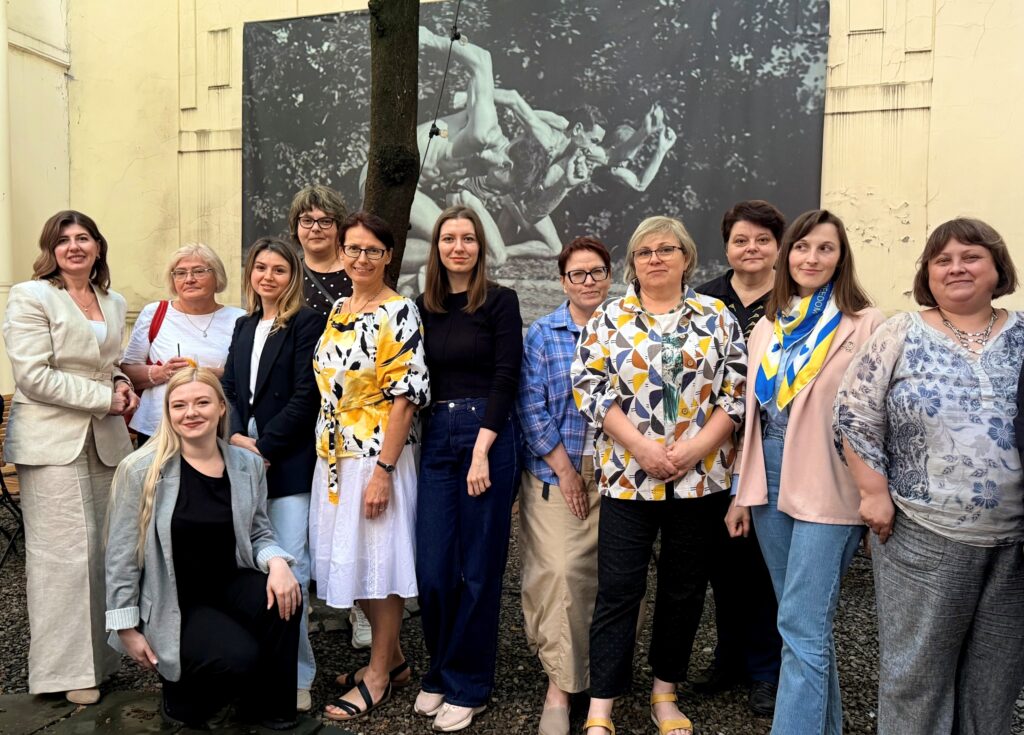
On June 12, 2026, a one-day workshop took place in Lviv as part of a joint project of the Ukrainian Association for Research in Women’s History (UARWH) and the Center for Urban History to develop educational materials for teaching women’s and gender history of Ukraine. The event was held in a hybrid format, with some researchers presenting their work remotely via Zoom.
As a result of the workshop, the REeSOURCES educational platform will be expanded with new primary sources (archival documents, personal reminiscences, and visual materials) on Ukrainian women’s and gender history, available to university educators in Ukraine and around the world free of charge.
Twenty researchers from various regions of Ukraine — Lviv, Kharkiv, Dnipro, Kyiv, Odesa, Zaporizhzhia, and Rivne, as well as from Germany and France took part in the event. The participants are historians and philologists who specialize in women’s history and draw on their own original research for this project. The project co-coordinators are Oksana Kis on behalf of UARWH and Ivanna Cherchovych on behalf of the Center for Urban History. The workshop program is available here.
In preparation for the workshop, each participant developed one or more historical primary sources (textual or visual), accompanied by a scholarly commentary that contextualizes the historical document and proposes directions for analysis. The materials illuminate diverse women’s experiences or gendered aspects of various phenomena, events, or processes in Ukraine, with no restrictions on topic, geography, or chronology.
During the workshop, the researchers presented their primary sources and draft analytical notes for peer discussion. Participants now have six weeks to finalize their work — completed, ready-to-use teaching materials are due by August 1, 2026, for publication on the REeSOURCES platform. The event was made possible with the financial support of VUIAS. The VUIAS grant covered all travel, accommodation, and meal expenses for participants. The venue and technical support were provided by the Center for Urban History.