
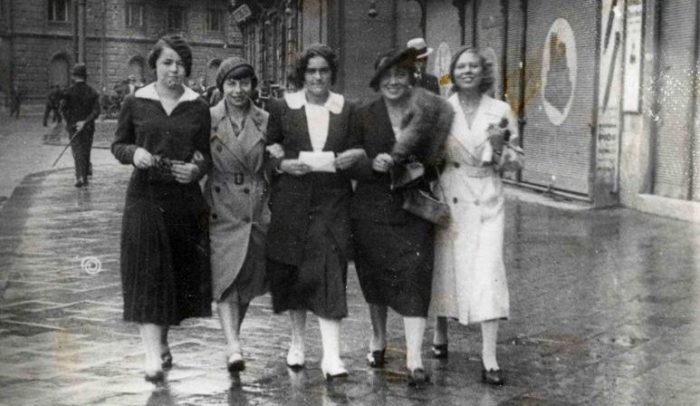
The Ukrainian Association for Research in Women’s History and the Center for Urban History, with the support of the Heinrich Böll Foundation, invite applications for participation in the International Conference marking the 10th anniversary of UARWH:
WOMEN’S DIMENSIONS OF THE PAST: IDEAS, EXPERIENCES, REPRESENTATIONS
Lviv, October 9–10, 2020
Submission deadline: June 15, 2020
The 10th anniversary of the Ukrainian Association for Research in Women’s History, founded in October 2010 in Lviv, is a wonderful occasion to discuss the state of research in women’s history in Ukraine, to survey achievements and identify challenges in the study of Ukrainian women’s past, and to reflect collectively on the prospects for this field and its role in modernizing Ukrainian historical scholarship and politics of history.
Throughout history, women have constituted at least half of humanity, yet their historical experience is barely reflected in chronicles or archives, and monographs and history textbooks tell us little about women. Only the names of those women who managed to enter and succeed in certain “male spheres” (primarily politics, warfare, religion, or education) have typically been inscribed into world and national History. But does this mean that women did not make History and merely lived through it passively? Or did they perhaps act in a different, less visible, yet no less significant way for the progress of society?
Modern and contemporary Ukrainian history is rich in dramatic events that radically affected the way of life of entire generations: governments and systems changed, laws and borders shifted, bloody wars and revolutions unfolded, vast groups of people were resettled voluntarily and by force, cities were built and villages destroyed, Ukrainian education and culture flourished and were repressed, citizens gained and lost rights, fought against authority and collaborated with it… Women were in one way or another involved in all historical processes on the territory of modern Ukraine — political, military, cultural, civic, economic, migratory, scholarly, and educational, among others. Yet their participation and role remain largely unknown.
What do we know about women’s lived historical experiences amid the turbulence of various historical events? How do we conceptualize women’s past during times of historical upheaval and in years of relative calm? How are women’s lived experiences represented in literature, art, and cinema? How have Ukrainian women changed under the influence of events they witnessed and participated in? Which sources can tell us most fully and reliably about women’s lives and activities? What can knowledge of women’s history offer for understanding contemporary processes in Ukraine?
We invite researchers of women’s and gender history, as well as specialists in other fields of social sciences and the humanities whose work has a clear historical dimension and focuses on gendered aspects of various spheres and phenomena, including but not limited to the following topics:
● Women’s everyday life: subcultures, practices, experiences;
● Gendered spaces: city, town, village, home;
● Women and the production of knowledge: education, science, expertise;
● Women and power: leadership, politics, self-governance;
● Women in times of wars and revolutions: violence, resistance, survival;
● Women’s rights: the organized women’s movement, feminist practices, grassroots activism;
● Gender of nations: national dimensions of women’s experience and agency;
● Women in professional environments: gender and labor;
● Women between tradition and innovation;
● Women and religions: images, statuses, roles, practices;
● Women’s stories of Otherness: beyond normativity;
● Women’s “voices” of the past: sources for the study of women’s history;
● Women’s images of the past: cultural representations of women’s experience (literature, visual art, cinema, museums);
● Women in transnational and transimperial dimensions: gendered aspects of migration;
● Through the male gaze: women in official and ego-documents.
Preference will be given to presentations aimed at posing and examining broader issues in women’s history through specific historical material, critically revisiting established historical views and assessments through the lens of gender, conceptualization and theoretical generalization based on the analysis of relevant historical sources, with elements of cross-cultural studies that demonstrate novelty of approach or address understudied topics. We welcome research that is relevant in light of current events and discussions in scholarship and society.
In shaping the conference program, the Organizing Committee prioritizes a problem-oriented, interdisciplinary approach over a chronological-thematic one. Descriptive, positivist, or factographic presentations and formulaic topics will not be considered. We discourage narrowly specialized studies that are of interest or accessible only to a limited circle of subject-area experts.
We encourage the participation of advanced undergraduate students, master’s students, and doctoral students whose scholarly interests focus on women’s and gender history.
The working language of the conference is Ukrainian.
Please send applications to the Conference Organizing Committee at uarwh2010@gmail.com by June 15, 2020.
Speakers selected for the Program must submit their full presentation text (5–7 pages) to the Organizing Committee by September 15, 2020 (to be shared with discussants).
Without a submitted text, the presentation will not be included in the final Conference Program. The final Conference Program and official invitations will be sent out by September 25, 2020.
The application must include:
● Information about the speaker: surname and first name, academic degree (Candidate or Doctor of Sciences) or education level (bachelor’s, master’s, etc.), specialization (discipline — e.g., history of Ukraine, ethnology, sociology, etc.), place of work or study, position/status, main research interests, and preferably a list of 2–3 scholarly publications in the field of women’s and gender history (if available). Additional information (in the form of links to personal web pages) is welcome.
● Presentation topic — formulated as clearly and concisely as possible.
● Abstract — 300–400 words, clearly identifying the subject of research, the main research question, briefly outlining the conceptual framework, indicating temporal and geographic scope, research sources and methods of analysis, as well as the main findings and conclusions.
The Organizing Committee reserves the right to reject presentations that do not align with the thematic focus and overall concept of the conference, or that are derivative in nature, lacking original analysis, or consist of abstract historiosophical speculation without grounding in specific source material. A collected volume based on conference materials is planned. The selection of texts for the volume will take place separately, following the conclusion of the conference.
IMPORTANT DATES:
● June 15, 2020 — submission deadline (speaker information, topic, and abstract)
● July 15, 2020 — Organizing Committee decision on inclusion in the conference program
● September 15, 2020 — submission of full presentation text (5–7 pages) to the Organizing Committee
● September 25, 2020 — finalization of the Conference Program and distribution of invitations to participants
Invited speakers from Ukraine will be provided with accommodation and meals for the duration of the conference, and travel costs will be partially reimbursed.
Organizing Committee:
● Oksana Kis, Doctor of Historical Sciences (habilitation equivalent), President of UARWH;
● Sofiia Diak, Candidate of Historical Sciences (Ph.D. equivalent), Director of the Center for Urban History;
● Olena Stiazhkina, Doctor of Historical Sciences (habilitation equivalent), Senior Research Fellow at the Institute of History of Ukraine, NAS of Ukraine;
● Mariana Baidak, Candidate of Historical Sciences (Ph.D. equivalent), Research Fellow at the Institute of Ethnology, National Academy of Sciences of Ukraine;
● Kateryna Kobchenko, Candidate of Historical Sciences (Ph.D. equivalent), Senior Research Fellow at the Center for Ukrainian Studies, Faculty of Philosophy, Shevchenko National University of Kyiv;
● Ivanna Cherchovych, Candidate of Historical Sciences (Ph.D. equivalent), independent researcher.
Logistics and communication:
Iryna Paslas, Viktoriia Panas, Mariana Mazurak (Center for Urban History)
Organizing Committee email: uarwh2010@gmail.com